How Stress Affects Your Success (And What to Do)
Explore how stress affects your focus, confidence and performance, with practical ways to manage everyday pressure.
Read GuideSome people thrive working independently. Others find that without the structure and social contact of a workplace, everything becomes harder.
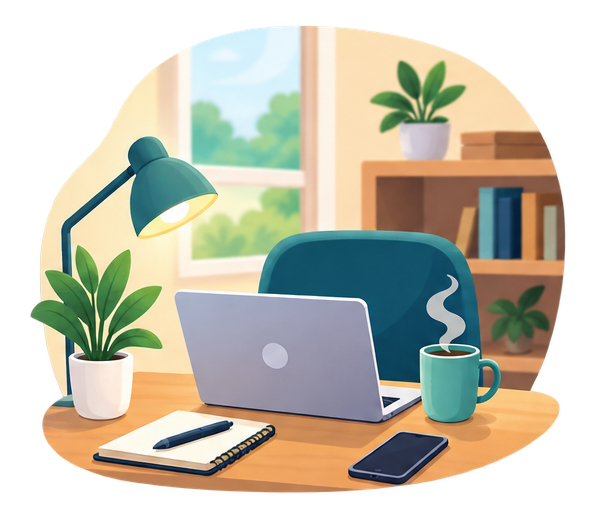
The important question isn’t whether working alone is good or bad.
It’s whether the way you work matches what you need to stay focused, motivated and connected.
“I get more done when nobody interrupts me.”
“Without other people around, I find it really hard to get started.”
“I love the freedom of working alone… but sometimes I feel completely disconnected.”
Working alone can remove distractions and give you more control—but it can also remove the structure, accountability and social contact that help you stay on track.
The key is understanding what helps you work at your best, rather than assuming you should be good at working alone.
Everything you need to know about executive function in less than a minute.
Working independently without the usual structure, supervision or social contact of a shared workplace.
Less structure and accountability can make it harder to stay focused, motivated and connected.
Procrastinating, getting distracted, working too long, feeling isolated or struggling to switch off.
Create structure, plan regular contact, protect your breaks and build clear boundaries around your working day.
Working alone is about more than simply having fewer people around you.
When the usual structure of a workplace disappears, you often have to create that structure for yourself.
Working independently may require you to:
Don’t judge yourself by how well you work alone.
If you concentrate better with structure, accountability or other people nearby, build those things into your working day. Changing your environment can be more effective than trying harder to concentrate.
Low confidence isn’t a personality flaw.
It’s often the result of years of trying hard in a world that didn’t understand how your ADHD brain works.
Self-understanding is often the first step towards rebuilding confidence.
Working alone removes many of the small cues and structures we barely notice in a shared workplace.
Other people arriving, starting tasks, taking lunch and finishing for the day all provide signals that help organise our own behaviour.
When you work alone, many of those signals disappear.
You may have to create your own structure for:
For some people, fewer interruptions actually make working easier.
For others, less external structure can make procrastination, distraction and motivation more difficult to manage.
And if you have ADHD, this can be particularly noticeable because planning, task initiation, time management and regulating attention are all linked to executive functioning.
Confidence grows through small experiences of success—not by waiting until you feel confident first.
You sit down to work… but without someone else around, it takes much longer to actually begin.
Your attention drifts to emails, household jobs, your phone or anything that feels easier than the task in front of you.
Days can pass with very little meaningful contact, and work can start to feel disconnected or lonely.
Without the physical boundary of leaving work, the working day quietly stretches into your evening.
These difficulties don’t mean working alone is wrong for you—they usually point to the kind of structure or support you need.
You don’t need to become more disciplined. Small changes to your working environment can give your brain more of the structure it needs.
Choose a simple cue that tells your brain work has begun — make a drink, open your planner or write down your first task.
Start with one clear task rather than your whole to-do list.
Working alone doesn’t have to mean doing everything alone.
Arrange a regular check-in with a colleague, use body doubling or tell someone what you plan to complete.
A little external accountability can make getting started much easier.
Don’t rely on willpower to ignore everything around you.
Put your phone out of reach, close unnecessary tabs and create a workspace with fewer competing demands.
Make focusing easier rather than expecting yourself to try harder.
In an office, conversations and breaks often happen naturally. When you work alone, you may need to create them deliberately.
Plan a lunchtime walk, call a colleague or work somewhere around other people occasionally.
Give your brain a clear signal that the working day has finished.
Close the laptop, write tomorrow’s first task and physically leave your workspace if you can.
Work needs an ending—even when you don’t leave the house.
Don’t copy someone else’s perfect working-from-home routine.
Ask instead:
“What structure disappears when I work alone—and how can I put some of it back?”
Our ADHD Practical Toolkit (£19) contains printable planners, reminder systems, checklists and psychologist-designed resources to reduce working memory overload in everyday life.
Explore how stress affects your focus, confidence and performance, with practical ways to manage everyday pressure.
Read Guide
Discover practical ways to improve listening, communication and understanding.
Read Guide

Understand how strong emotions influence your thoughts, reactions and decisions.
Read GuideWorking alongside Dr Yates, Paul ensures that services are well organised, accessible and delivered with care.
Paul oversees client relationships and supports the smooth running and development of YPS, helping individuals, families and organisations feel confident and supported from first contact onwards.
Paul’s focus includes:
Paul leads on client relationship management, service coordination and organisational development. Paul works closely with schools, families and partner organisations to ensure clarity of communication, timely delivery and high service standards.
He supports referral pathways, contractual arrangements and long-term partnership development, helping ensure services remain consistent, reliable and professionally delivered.
Outside of work, Paul’s main passion is Walking Football. He plays for East Devon, Devonshire County, and South West County. His biggest achievement is having trials with the Over 50s England Walking Football group in 2025. He also enjoys restoring and driving classic cars.
BSc Hons in Tourism Management, Tourism, and Business Management, MSc Psychology Conversion, MSc Occupational Psychology
Working under the clinical supervision of Dr Yvonne Yates, Joseph supports the assessment and development of psychological services across the organisation.
Joseph’s work focuses on:
He has a strong interest in evidence-based psychology and values clarity, structure and ethical practice.
Outside of work, Joseph enjoys spending time with his springer spaniel, Willow, and going for long walks with her and the family. When he can, he hits the ski slopes on his snowboard, and he also likes ice-skating.
HCPC-Registered Educational Psychologist | Founder, YPS Psychology Ltd
Dr Yates has specialist expertise in ADHD, depression, anxiety, learning differences (SpLD), and emotional wellbeing with children, young people, and adults.
She holds a Doctorate in Psychology (University of Manchester) and has extensive experience delivering:
• Educational psychology assessments, including ADHD and SpLD
• Mental health assessment and therapy
• Social skills and emotional regulation support
Dr Yates has worked in public organisations, including, schools, the NHS, and local authorities, and in private practice, for universities, colleges, and therapy healthcare bodies, such as, AXA PPP and Bupa.
She is the author of Human Givens Therapy with Adolescents (Jessica Kingsley Publishers) and has published peer-reviewed research on adolescent wellbeing.
Her approach combines evidence-based psychology with practical, real-life strategies that help individuals feel calmer, more confident, and better equipped to succeed at school, university, and work.
Outside of work, Dr Yates is an avid crocheter and is also quite partial to silent discos. She looks forward to spending evenings by the fire, and watching movies with the family whilst creating her latest crochet piece.